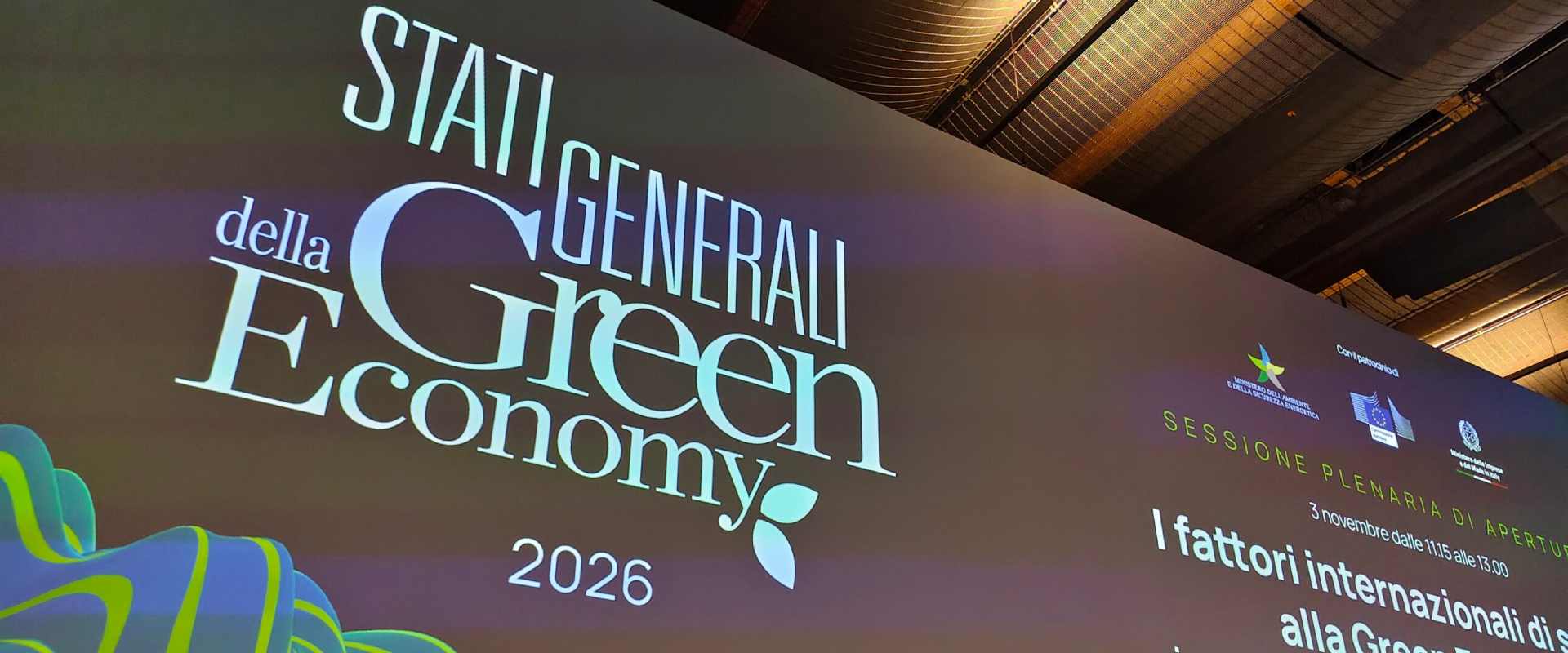
Green Economy General Assembly 2026
The ecological transition is a structural necessity and Italy leads Europe in the circular economy
Along this pathway, climate protection, resource regeneration and production process efficiency are no longer mere environmental goals and instead become the core principles of countries’ industrial competitiveness and socio-economic resilience. Guided by this vision, the Green Economy General Assembly 2026 got under way in Rimini as part of Ecomondo (IEG – Italian Exhibition Group), launched with the presentation of the new Report on the State of the Green Economy. Promoted by the Fondazione per lo Sviluppo Sostenibile (Sustainable Development Foundation) with backing from the Italian Ministry of the Environment and Energy Security, the European Commission and the Italian Ministry of Enterprises and Made in Italy, this document serves first and foremost as a strategic guidance tool and a reliable benchmark for reporting the country’s achievements to stakeholders, helping raise public awareness and integrate sustainability into corporate strategies.
Against an international backdrop marked by considerable economic uncertainty and growing climate threats, the past year has confirmed, as highlighted by President Edo Ronchi citing the UN Partnership for Action on Green Economy report, that the ecological transition is now a structural necessity and a tangible driver for growth and social inclusion, supported in Italy by an increasingly committed push from citizens and businesses, as shown by the IPSOS survey. This document charts the evolution of a national system required to tackle the challenges of a complex situation, one that generally shows more shadow than light, yet displays important signs of vitality across the regions. In fact, the Report does not merely provide a snapshot of the ground to be made up in terms of the climate, energy and water, but it also highlights the pillars underpinning national productive resilience, confirming Italy’s leading position in Europe for the circular economy and waste management towards a meaningful, far-reaching ecological transition.
The national landscape: the challenges of the climate, energy and land protection
At the heart of the overall analysis lies the urgent need to step up the pace of decarbonisation and environmental safety policies. Located at the heart of the Mediterranean climate hotspot, with average temperatures up by more than 2°C over the past fifty years, over 2,300 extreme weather events in 2025 and a summer of 2026 marked by extended “red alert” heat warnings across the peninsula, Italy has seen its downward trend in greenhouse gas emissions grind to a halt: following years of decreases, 2025 recorded a slight rebound, which now means the country has to double the pace of its cuts from 7 to 14 million tonnes per year to meet its 2030 NECP targets. This vulnerability is also reflected in Italy’s high dependency on foreign energy, still standing at 74% compared with the European average of 57%, and in its gaps in renewable energy sources, which account for 19.6% of total final consumption (compared with the target of 39.4% for 2030) and 47% of electricity generation, with 7.2 GW of new systems installed in 2025 in contrast to the 10 GW per year needed. At the same time, the country faces severe pressure on its natural resources, topping the European table for domestic and industrial water withdrawals (with network losses exceeding 40% and treated waste water reuse languishing at 4% compared with a potential of 23%) and reaching net land consumption of 21.5 hectares per day. However, these critical issues are countered by the strength of Italy’s PDO agri-food economy and the innovative urban planning of Italian cities, which are increasingly committed to climate adaptation through climate shelters and “sponge city” initiatives featuring de-paved surfaces to absorb and reuse rainwater.
Circular economy: the efficient use of material as a driver for growth
Compared with the rest of Europe, the most advanced achievements of Italy’s green economy rely on a clear industrial strategy: turning a lack of natural resources into production efficiency, prioritising material recovery and reducing exposure to global supply chain disruptions. In a world where the linear economic model has more than tripled material consumption since 1970, the European Union has placed recycling at the heart of its industrial security strategies, setting a target under the Critical Raw Materials Act to cover at least 25% of the EU’s strategic demand through waste recovery by 2030. Against this increasingly demanding backdrop, Italy (which still depends on imports for 47.1% of the materials it consumes, more than double the EU average of 22.1%) has managed to consolidate its continental leadership in the circular use of resources. Out of the total 776 million tonnes of raw materials processed annually by the national system, recycling and backfilling operations already directly reintroduce more than 134 million tonnes of material back into the production cycle, accounting for 18% of total demand. This focus on resources is positively reflected in the main macroeconomic indicators: in 2025, Italy confirmed its top spot in Europe for resource productivity, generating €4.60 of GDP for every kilogram of material consumed (compared with the EU average of €3/kg, Germany’s €3.90 and €3.80 for France and Spain), and also leads the major European economies in its circular material use (CMU) rate, with recycled secondary raw materials meeting 21.6% of national demand compared with the European average of 12.2%.
Waste management and recycling supply chains: a leading position in Europe ahead of 2030 targets
The success of Italy’s circular economy goes hand in hand with the technical and plant-engineering strength of its environmental management supply chain capable of recovering value from waste and minimising final disposal. Ongoing investments in the quality of treatment and recovery processes have allowed Italy to achieve an outstanding milestone across the EU: the country actually sends 85.6% of all its waste produced for recycling (86% in Eurostat comparisons), a figure more than double the EU average, which languishes at 41%. By combining material recovery with a 5% share of energy recovery, this exemplary model has made it possible to restrict landfilling and other disposal operations to just 9% of treated waste, compared with a European average that still stands at 38%. This operational effectiveness covers the entire packaging supply chain, whose overall recycling rate increased to 77.3% in 2025, compared with 76.4% the previous year, surpassing the EU average by almost ten percentage points. Thanks to this performance, the country has not only met all its 2025 European targets ahead of schedule – including plastics at 50.5% – but has already exceeded the 2030 targets set for paper, glass, wood, aluminium and steel. This solid industrial backbone provides the foundation for developing the new environmental investments recommended by the European Commission to further strengthen the circular economy, pollution prevention and soil restoration.
For a more detailed look at the projects, figures and scenarios in this annual snapshot, the full 2026 Report on the State of the Green Economy is available to view and download in the Documents section of the official Green Economy General Assembly website.
Sources
2026 Report on the State of the Green Economy in Documents 2026 Events | Green Economy General Assembly 2026